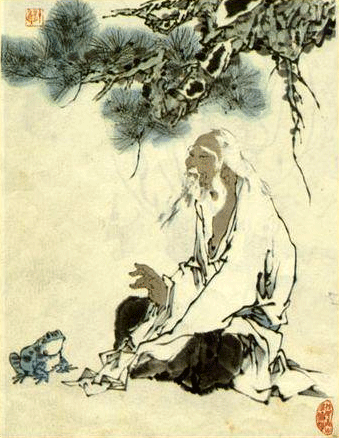
The Dance of Gathering and Scattering
Chuang Tzu's assertion, "If it gathers, there is life. If it scatters, there is death," invites us to contemplate the dynamic interplay between unity and disintegration in our existence. This quote encapsulates the essence of life as a process of coming together, a gathering of energies, intentions, and relationships that foster vitality. Conversely, the scattering signifies a disconnection, a fragmentation that leads to a sense of loss or death. Understanding this duality is crucial, as it reveals the underlying principles of Taoist philosophy and the nature of our own lives.
In a world often characterized by chaos and fragmentation, Chuang Tzu's words resonate deeply, urging us to recognize the significance of connection and the impermanence of all things. The gathering of life can be seen in moments of community, shared experiences, and the nurturing of relationships, while scattering reflects the inevitable changes and separations we encounter. This quote serves as a reminder of the transient nature of existence, prompting us to embrace the moments of gathering while acknowledging the inevitability of scattering. It is within this tension that we find the essence of our human experience.
The image / the metaphor
The imagery in Chuang Tzu's quote evokes a vivid sense of movement and transformation. The verb "gathers" suggests a coming together, a convergence of energies that creates a vibrant tapestry of life. In contrast, "scatters" conveys a sense of disarray, a dispersal that leads to fragmentation and loss. This duality encapsulates the cyclical nature of existence, where moments of unity are often followed by periods of separation, reflecting the rhythm of breath itself—inhale and exhale, life and death.
Delving deeper into the metaphor, we can see that gathering is not merely a physical act but also an emotional and spiritual one. It represents the connections we forge with others, the passions we pursue, and the dreams we cultivate. Scattering, on the other hand, can symbolize the inevitable changes we face, such as the end of relationships, the loss of loved ones, or the dissolution of once-vibrant aspirations. This interplay between gathering and scattering invites us to reflect on how we navigate these cycles, encouraging us to find meaning in both the coming together and the letting go.
In the speaker's tradition
Chuang Tzu's insights are deeply rooted in the Taoist tradition, which emphasizes the interconnectedness of all things and the importance of aligning oneself with the natural flow of the universe. Concepts such as *wu wei* (non-action) and *yin-yang* illustrate the balance between opposites, highlighting that life is a continuous dance between gathering and scattering. In this context, the quote can be seen as a reflection of the Taoist understanding of *dao*, the way or path that guides us through the complexities of existence.
Moreover, the notion of impermanence is echoed in other philosophical traditions, such as Buddhism's concept of *anicca*, which teaches that all things are transient and subject to change. In the *Zhuangzi*, the text from which this quote is derived, we find numerous anecdotes illustrating the fluidity of life and the importance of embracing change. One such story involves a butterfly dreaming of being a man, only to awaken and question the nature of reality itself, underscoring the idea that our perceptions of life and death are often intertwined and fluid.
Living the teaching
Consider a modern scenario where this teaching manifests: a community coming together for a shared purpose, such as a local environmental initiative. In this gathering, individuals unite their energies, talents, and passions to create a positive impact. The act of gathering fosters a sense of belonging and purpose, illustrating the vitality that emerges when people connect over a common goal. However, as the project concludes, the community may experience a scattering of its members, each returning to their individual lives. This cycle of gathering and scattering reflects the ebb and flow of life, reminding us of the importance of cherishing moments of connection.
In a more personal context, consider a relationship that has deepened over time. The moments spent together—sharing laughter, dreams, and vulnerabilities—represent the gathering of life. Yet, as circumstances change, such as a job relocation or differing life paths, the relationship may scatter, leading to feelings of loss. This teaching invites us to honor both the joy of connection and the pain of separation, recognizing that each phase contributes to our growth and understanding of love. By embracing the impermanence of relationships, we can cultivate a deeper appreciation for the moments we share.
A reflection
As we contemplate Chuang Tzu's profound words, we are invited to reflect on our own lives: In what ways do we gather and scatter? Are there connections we cherish that require nurturing, or are there aspects of our lives that need to be released? This contemplation encourages us to engage with the cycles of our existence, embracing the beauty of gathering while acknowledging the inevitability of scattering. How can we find peace in this dance of life, allowing ourselves to be fully present in both the moments of unity and the experiences of letting go?



Join the BrightStar Community
Stay connected with daily inspiration, event announcements, and community wisdom